EUROPE - In the midst of heated criticism, the European Parliament will launch a probe into the meteoric rise of the German, Martin Selmayr, to the position of EU Commission's General Secretary. Selmayr, a controversial figure in the Brussels' bureaucracy, rose to the top of an administration, with a staff of 32,000, under circumstances many consider quite dubious.
USA - Scientists from Northwestern University published a study in the journal Neuropsychologia attempting to establish a link between religious fundamentalism and brain impairment. The findings suggest that religious fundamentalists have less cognitive flexibility, in addition, the study states that damage to particular areas of the prefrontal cortex indirectly promotes religious fundamentalism. In other words, science is now attempting to say that those who believe the Bible have brain damage.
SOUTH AFRICA - White farmers in South Africa are being murdered at a rate of more than one per week, as the country's new President Cyril Ramaphosa vows to seize back land without compensation. News Corp Australia chief reporter Paul Toohey, who travelled to South Africa to investigate, has told Sky News farmers are struggling to defend themselves, and local police are not dedicating enough resources to investigate the crimes. More than 400 farmers were attacked in 2017.
USA - Facebook said on Wednesday it banned Britain First from its platform for breaking rules against inciting hatred, blacklisting a far-right group brought to global attention when US President Donald Trump retweeted its anti-Islamic posts. Facebook said it had taken down Britain First's Facebook page and those of its leaders, Paul Golding and Jayda Fransen, for repeatedly violating rules designed to stop the incitement of hatred against minority groups. The removal of the Britain First pages comes as Facebook and other internet firms like Twitter and Google are under growing pressure to police their networks, refereeing content to prevent extremist groups spreading their messages and recruiting online.
SWITZERLAND - The World Health Organisation (WHO) has announced a review into the potential risks of plastic in drinking water after a new analysis of some of the world’s most popular bottled water brands found that more than 90% contained tiny pieces of plastic. A previous study also found high levels of microplastics in tap water. In the new study, analysis of 259 bottles from 19 locations in nine countries across 11 different brands found an average of 325 plastic particles for every litre of water being sold. Concentrations were as high as 10,000 plastic pieces for every litre of water. Of the 259 bottles tested, only 17 were free of plastics, according to the study. The study has not been published in a journal and has not been through scientific peer review.
RUSSIA - Russia has vowed to strike back after Britain moved to banish 23 Russian spooks within a week in the wake of the spy poisoning scandal. Responding to Theresa May's announcement that diplomats who are really spies will be booted out, Moscow threatened its "response measures will not be long in coming".
UK - BBC host Andrew Neil has taken a swipe at Russia and claimed the alleged assassination attempt of former double-agent Sergei Skripal was a "calculated" strike designed to send a message to Putin's enemies. The BBC host claimed it would have been easier for Russia to hire a hitman to do the job if Putin did not want to be found out and accused of the alleged crime. Speaking on BBC Daily Politics, Mr Neil said: “Is it reckless behaviour? Because you don’t use this as a means of assassination without knowing that it’s going to be found out. And you don’t do this unless you want to be found out, unless you are attempting to send a message. That’s not reckless, that’s calculated. That’s clear.”
UK - Accusations of a chemical weapon attack — and a major diplomatic crisis just days before a presidential election — might give some world leaders pause for thought. Not Vladimir Putin. Faced with an ultimatum from Prime Minister Theresa May over an attempted assassination on British soil, the Russian strongman is making a show of just how strong he thinks he is — among his own voters, and on the international stage.
GERMANY - A bank employee from the provinces, a pair of unsuccessful candidates for state governorships and the architect of the Social Democrats’ terrible election campaign are among the 15 men and women who will be sworn in as members of Angela Merkel’s Cabinet on Wednesday. The most remarkable thing about the new government might be how unremarkable it is. No larger-than-life personalities such as Joschka Fischer, no rapier wit to match that of Wolfgang Schäuble and no charmer like Karl Theodor zu Guttenberg. The chancellor’s newest and likely last team is much like her — dependable, if a bit boring. After the tumultuous, six-month coalition-building phase, boring might be a good thing. More drama is the last thing Germans want.
GERMANY - Germany’s new grand coalition – the third in Merkel’s long chancellorship – is a good outcome for Germany’s short-term stability, especially with regard to Europe. But it is a bad outcome for democracy, especially at a time when populist forces are a growing threat.
USA - Some of the deadliest massacres in US history were carried out with guns imported from Europe or produced by European-owned companies in the US with firearms that are either heavily regulated or banned in Europe. While Europeans decry America's gun obsession, European gun-makers have no qualms about selling firearms to the US that are tightly regulated at home. It comes as no surprise to discover where those guns pop up. In 2016, European-origin guns accounted for four million of an estimated 16 million US civilian gun market. It shows that European gun-makers have kept pace with the market and ratcheted up their sales to Americans accordingly.
HUNGARY - The National Bank of Hungary (MNB) has announced it is bringing home the country’s 100,000 ounces (3 tons) of gold reserves from London. The decision to repatriate gold reserves, in total worth some 33 billion Hungarian forint (US$130 million), was also explained as being for safety reasons, in case of a potential geopolitical crisis. It is also in line with international trends as storage of gold reserves out of the country is now considered risky by many central banks, including Austrian, German and Dutch regulators. They have recently decided to repatriate their gold reserves. At the beginning of 2010, the tendency to keep reserves outside the country changed again and central banks have started to accumulate gold as a potential response to a financial crisis.
UK - Humans must leave Earth in the next 200 years if we want to survive. That was the stark warning issued by Professor Stephen Hawking in the months before his death today at the age of 76. The legendary physicist believed that life on Earth could be wiped out by a disaster such as an asteroid strike, AI or an alien invasion. He also warned over-population, human aggression and climate change could cause humanity to self-destruct. He believed, if our species had any hope of survival, future generations would need to forge a new life in space.
UK - Celebrity atheist Richard Dawkins recently tweeted asking his followers’ thoughts on starting a cannibal diet. Linking to an article about lab-grown flesh, the evolutionary biologist wrote: "I've long been looking forward to this," he wrote. "What if human meat is grown? Could we overcome our taboo against cannibalism?” He went on to say the scientific breakthrough will be an “interesting test case for the consequentialist morality versus ‘yuck reaction’ absolutism.” The question of whether people would eat artificially created human flesh has been raised before. Matti Wilks, of the University of Queensland, Australia, conducted a study into how people feel about the issue. And unsurprisingly, only a tiny proportion of people would be prepared to eat lab-grown human, dog, cat or horse meat.
USA - Donald Trump’s recent announcement of extensive tariffs on metal imports sparking a potential trade war with the EU could have as much of a global impact as the UK’s decision to leave the bloc in 2016, an expert has claimed.
Disclaimer:
The views expressed in this section are not our own, unless specifically stated, but are provided to highlight what may prove to be prophetically relevant material appearing in the media.
“Just what is an APOSTLE?”
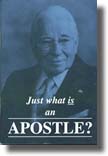
Today we find the Church of God in a “wilderness of religious confusion!”
The confusion is not merely around the Church – within the religions of the world outside – but WITHIN the very heart of The True Church itself!
Read online or contact email to request a copy